
Why NZ Dairy Needs a Data Layer

We export $20 billion in dairy every year. Yet most farms still rely on manual checks and morning walk-arounds. The gap between the cow and the tanker is where New Zealand's competitive edge is quietly eroding.
$20B
NZ dairy exports annually
2030
Global traceability commitments deadline
<5%
Farms with real-time supply chain data
The Weight of What We Export
New Zealand’s dairy sector is one of the most export-dependent in the world. We produce far more milk than our population could ever consume, and the difference; butter, cheese, infant formula, whole milk powder flows to over 130 countries. That $20 billion figure isn’t an abstraction. It’s livelihoods, rural communities, and a significant slice of our GDP riding on the reputation of what comes off New Zealand farms.
That reputation rests on a simple promise: what we say is in the product is what’s in the product. Clean, green, traceable. For decades, that promise has been enough. But the ground is shifting beneath the industry’s feet, and the window to adapt is narrowing.
“The gap between the cow and the tanker is where New Zealand’s competitive edge is quietly eroding.”
The Data Gap Nobody Talks About
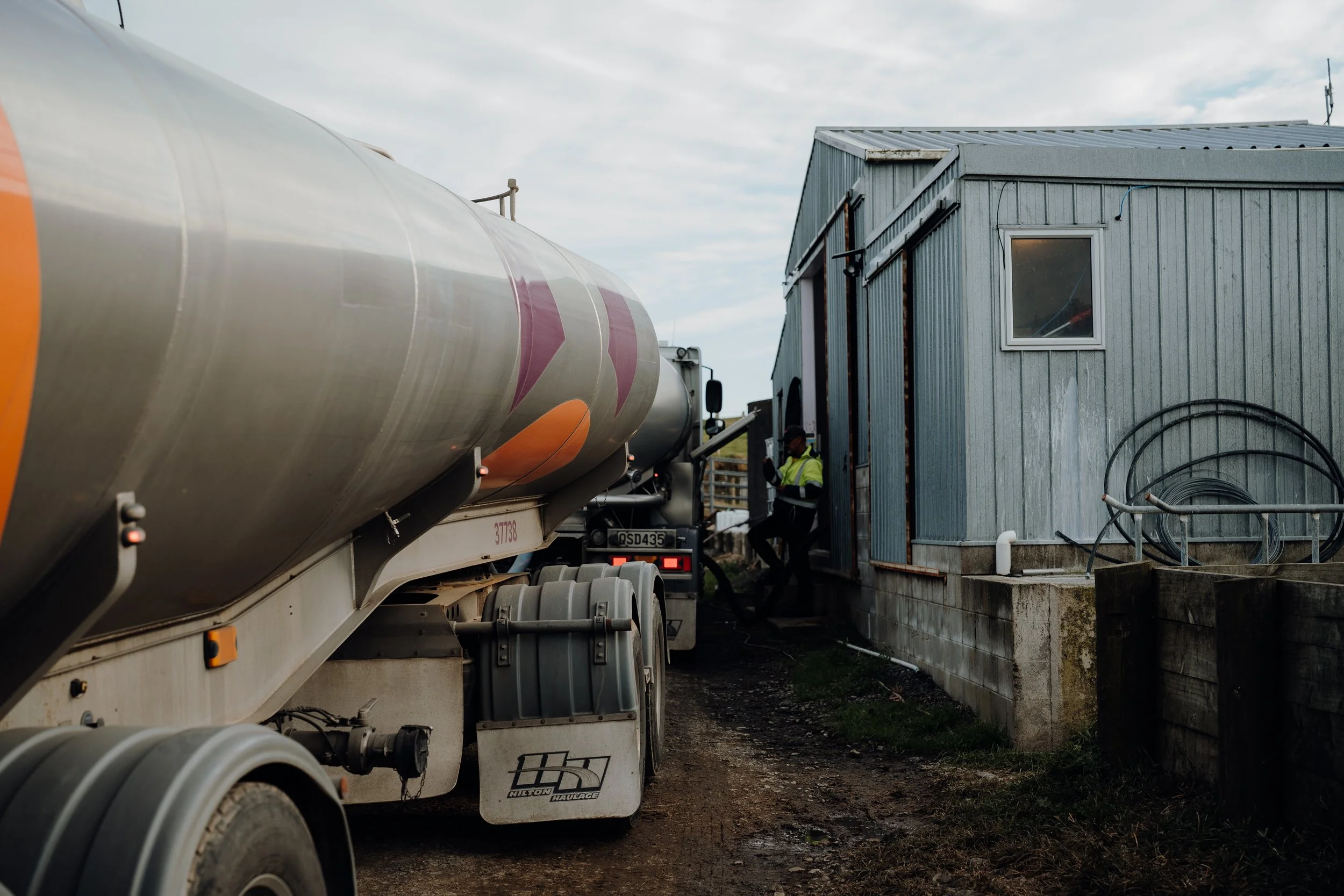
Here’s what a typical morning looks like on most New Zealand dairy farms: the farmer completes the milking, does a walk-around, checks the vat, makes a mental note of anything unusual, and logs a paper record, or nothing at all. The tanker arrives, the milk is collected, and that batch enters the supply chain carrying almost no farm-level data with it.
No real-time temperature record from the vat overnight. No automated hygiene verification. No continuous monitoring of animal health indicators that might affect milk quality. Just the farmer’s word and a basic chemistry test at the factory gate.
This isn’t a criticism of farmers — it’s a structural gap. The technology to capture this data exists. The integration layer that would make it useful, accessible, and auditable does not — at least not at scale in New Zealand.
What falls through the cracks today
• Vat temperature fluctuations between collection and pickup go unrecorded
• Hygiene events; CIP cycles, teat spray, liner changes are manually logged or missed entirely
• Animal health events affecting milk quality have no direct link to batch data
• Farm-to-factory traceability relies on paperwork, not real-time telemetry
• Audit trails are reconstructed after the fact rather than captured live
What Processors Actually Need
Ask anyone at Fonterra, Westland, or Synlait what keeps them up at night, and traceability will be near the top of the list. It’s not just about food safety incidents - though those, when they happen, are catastrophic. It’s about the increasing expectations of export markets.
The EU’s Farm to Fork strategy, China’s evolving infant formula regulations, and broader ESG reporting requirements from major retail customers are all moving in the same direction: processors will need to demonstrate farm-level data, not just factory-gate data. “Trust us” is no longer a sufficient answer to a European retailer asking about animal welfare, antibiotic use, or carbon footprint per kilogram of product.
Processors need visibility into the supply chain that begins at the farm, not the factory. That means knowing the condition of every batch before the tanker arrives. It means being able to pull an audit trail for any SKU back to the source farm. And it means having the data infrastructure to report against sustainability commitments that their customers are demanding with increasing urgency.
“By 2030, farm-level data won’t be a competitive differentiator for New Zealand dairy — it will be the cost of entry to premium markets.”

The Integrated Data Stack
Solving this requires more than a sensor on a vat. It requires an integrated data stack, a connected system that links hardware (sensors, monitors, telemetry devices), hygiene verification systems, and farm management software into a single coherent view.
Think of it in three layers. At the base, hardware: IoT devices capturing real-time temperature, flow rates, CIP cycles, and animal health signals. In the middle, a telemetry layer that transmits, stores, and normalises that data, accounting for connectivity gaps, device failures, and the messy realities of farm environments. At the top, an application layer that makes this data legible to processors, auditors, and farmers themselves.
The challenge isn’t any one of these layers in isolation. It’s building them to work together, in New Zealand’s specific farming context, at a cost that makes adoption realistic for the thousands of family farms that form the backbone of our supply chain.
Built End-to-End, Built for New Zealand
Terravest is the only New Zealand company building this entire stack; from the hardware on-farm to the data platform that processors and supply chain managers can actually use.
We’re not a sensor company that stops at the farm gate. We’re not a software business retrofitting generic IoT tools to a context they weren’t designed for. We’ve built specifically for the New Zealand dairy supply chain: the connectivity constraints of rural properties, the compliance requirements of Fonterra and co-operative structures, and the operational reality of farm teams who need systems that work without adding complexity.
Our platform connects farm-level hygiene and telemetry data directly to processor systems, creating a living audit trail that exists before anyone asks for it. When a recall happens, or when a major customer asks for a sustainability report, the data is already there.
This isn’t a future vision. It’s infrastructure that’s operating on farms across New Zealand today, and we’re scaling fast to meet the 2030 deadline that the industry has quietly committed to, whether it’s ready or not.
READY TO CLOSE THE DATA GAP?
We work directly with processors and co-operatives to deploy farm-level visibility across their supplier base.
Kip.Bodle@terravest.co.nz